
The Renaissance Method
Master the fundamentals. Connect them across subjects. Prove it every trimester with a signature project for a real audience.
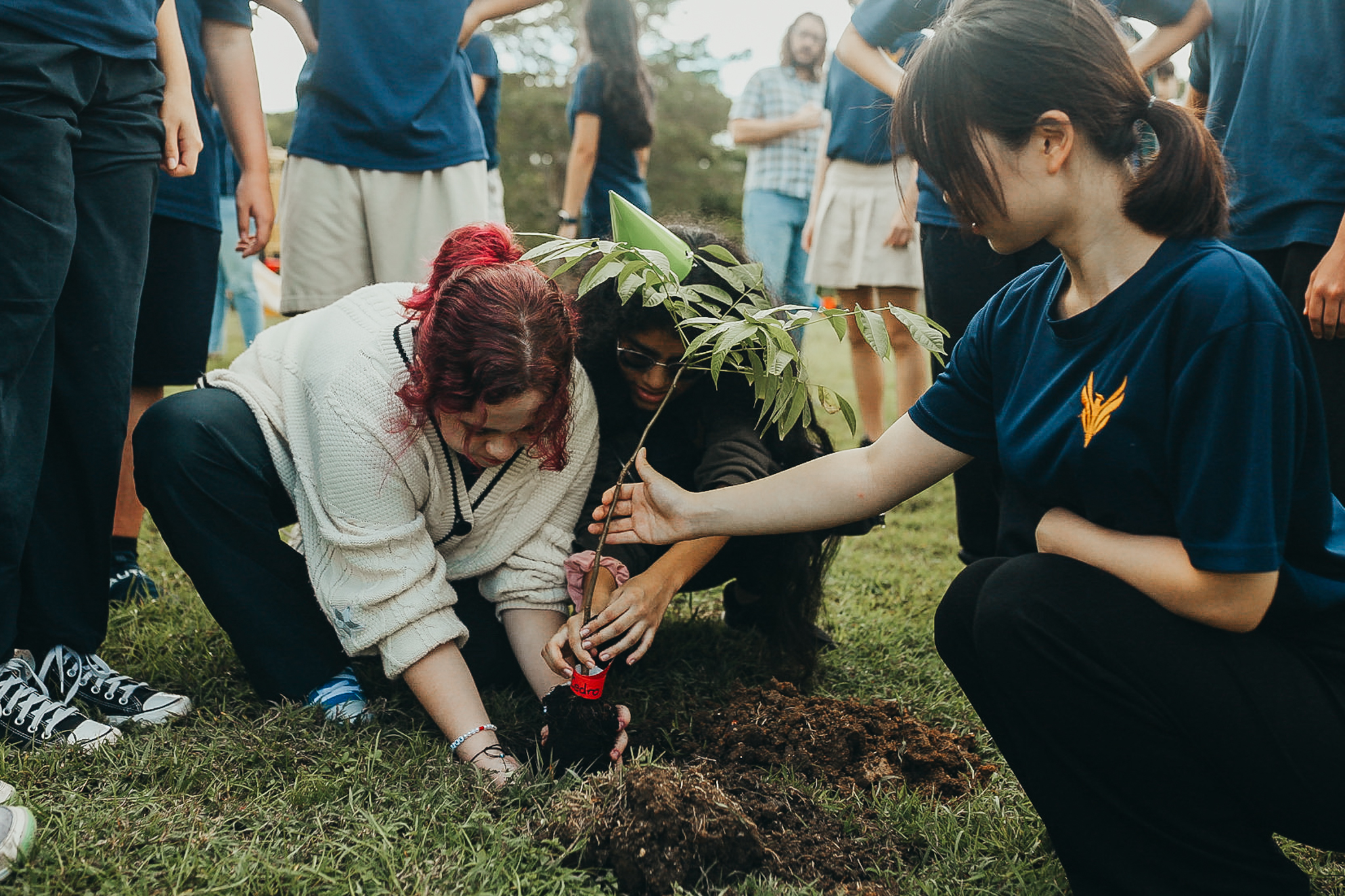
Like a Renaissance workshop
In a Renaissance workshop, apprentices mastered the craft before they made a masterpiece. Our classrooms work the same way: fundamentals first, then connected thinking, then work students present with pride.
Master
Short, clear teaching and daily practice build fluency in reading, writing and mathematics, so students have something solid to think with.
Connect
Subjects meet around a shared concept and essential question each trimester, so students see how ideas fit together and link to the place they live.
Prove
Each trimester ends with a signature project presented to a real audience, and students explain what they learned in their own words.
One clear shape, in every class
From PK2 to Grade 12, lessons follow the same seven steps. Children always know what comes next, so their energy goes into thinking.
Welcome at the door
Every student is greeted by name on the way in.
Do Now
A short task, ready on arrival, that wakes up what students already know.
Connect
The teacher links today's lesson to what came before and to the big question of the trimester.
Teach
Short, explicit teaching of one new idea or skill.
Think together
Students talk, question and reason out loud, and every student is expected to answer.
Practice
Students apply the skill on their own or in small groups while the teacher checks and coaches.
Share and close
Students explain what they learned in their own words.
Eight principles
Curiosity and integrity, put into practice in every classroom.
Students do the thinking
The person doing the thinking is the person learning.
Every student answers
Random calling gives every child an equal chance, and an equal expectation, to answer.
Fundamentals before flourish
Rigor comes from how deeply we treat a text or a problem, not from making it harder.
High expectations, every day
The standard is the same on Monday and on Friday, in every room.
Every learner known by evidence
MAP Growth, IXL and classwork show where each learner is and what comes next.
Practice the skill, not the worksheet
Stations and small groups target the exact skill a student needs.
Everything connects
Ideas link across subjects, across grades and to the place we live.
The work is the student's own
Students show their learning and explain it in their own words.
How it grows with your child
The lesson shape stays the same. What changes is who holds the conversation: the teacher leads early on, and by high school the students do.
Guided play
Teachers set up rich play with a clear learning goal. Circle time, learning centers and shared reading build language, curiosity and early skills, with hands-on materials before screens.
I do, we do, you do
Teachers model, practice with the class, then hand over. Students learn routines for working on their own while the teacher meets small groups.
Reciprocal teaching
In teams with rotating roles, students predict, question, clarify and summarize, and start answering each other instead of the teacher. By Grade 5, they build their own study guides.
Socratic seminar
Each unit includes a seminar, with an inner circle in discussion and an outer circle observing. Students learn to defend a claim with evidence.
Toward Harkness
Students prepare and lead the discussion while the teacher maps and coaches. In math and science, students present and debate their solutions.
How we measure progress
Every stage has a clear goal and a way to measure it, so you always know where your child stands.
Creative Curriculum GOLD
Teachers observe and record each child's development in language, thinking, movement and social skills.
MAP Growth
Assessments at the start, middle and end of the year show each student's growth and guide what teachers teach next.
Signature projects
Students present their work to a real audience and reflect on it in their portfolio, so learning is visible to families.
Mastery before AI
The effort is the learning. Students build their own thinking first, with books, paper and pencil, and conversation with people.
- No generative AI for schoolwork through Grade 10, in class or at home
- In Grades 11 and 12, only under teacher supervision, in tasks the teacher designs
- Practice platforms like IXL and ALEKS stay, because they build skill instead of replacing it
- Students learn about AI, not with it
Keep homework free of AI helpers
That includes photo-solver apps and AI writing features. When work may not be a student's own, we talk first: the student explains it, or redoes it with the teacher, and the family is told. We never treat an AI detector as proof.
Inclusion is the method done well for every learner. Each student belongs to their classroom teacher, support comes into the room first, and our Torchlight program adds small-group and one-on-one support when a student needs it.
Watch the method in a real classroom
Visit TRAIL while lessons are in session, Monday to Friday, by appointment.
Grades 6 to 12
See how discussion grows into student-led seminars, and how every graduate earns two diplomas.